Description
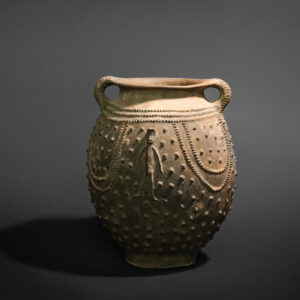
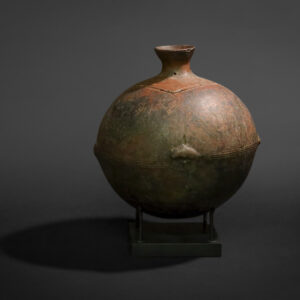
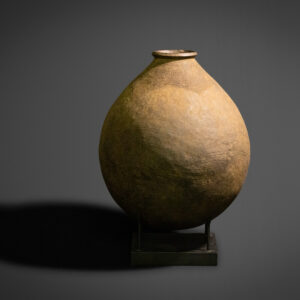
This Makonde water vessel from Mozambique is a full, generous form: 16 inches high and 18 inches across at the shoulder. A short flared neck rises from a broad, rounded body, and the burnished surface is a deep charcoal brown. Fine engraved lines, softened with pale clay, run around the upper half of the pot. As a result, the vessel reads at once as a working object and as a carefully drawn surface.
Catalogue Note on the Makonde Water Vessel
The neck carries a series of narrow incised rings. Below it, the shoulder holds the main frieze: a wide band of hatched triangles set in a zigzag, divided at intervals by paired vertical motifs worked in a braided pattern. Several bands of the same braided, rope-like incision then circle the widest part of the body. In contrast, the lower half is left plain and burnished, which lets the engraving stand out. The vessel is presented on a woven beaded ring stand in black and white.
Nkova: Designs Shared by Pot and Body
Among the Makonde, a woman commissions a vessel like this from a potter and keeps it for life. The potter builds the form by hand, coats it with a slip and burnishes it to a soft sheen. She then incises the design, and a kaolin wash rubbed into the lines makes the pattern glow white. Over years of use, that wash slowly wears away. The patterns often follow the tattoos and scarification once worn by the vessel’s owner. In fact, the Makonde word nkova describes both drawing on pottery and marking the skin. Museums therefore describe such a pot as an extension of its owner’s body and identity.
Water, Daily Life and Use
In rural Mozambique, women often walk long distances to collect water each day. They carry vessels of this type on the head, and the porous terracotta keeps the water cool in storage. Because the pot is carried high, its decoration is placed where others see it most: on the shoulder and around the neck. Moreover, the textured lines give the hands a better grip. When a vessel is no longer watertight, families may reuse it to store grain.
Condition and Specifications
- Culture: Makonde peoples, Mozambique
- Type: engraved water vessel (chilongo chakumuto)
- Medium: hand-built terracotta, burnished, with incised decoration and kaolin
- Dimensions: 16 in high, 18 x 18 in diameter
- Condition: excellent, with minor hairline cracks on the top side of the neck
- Presentation: shown on a woven beaded ring stand
Explore the Collection
Discover more in our pottery and terra-cotta collection, or browse all antiques and ethnographic objects. You may also appreciate the Tsonga uphiso vessel, also from Mozambique, and the Azande altar vessel. To view this Makonde water vessel in person, visit our Burlington showroom or book a private consultation. For broader context, read about the Makonde people.
References
Cleveland Museum of Art. “Water or Grain Vessel (chilongo chakumuto),” 1998.151.
North Carolina Museum of Art. “Water Vessel (chilongo chakumuto),” 2017.20.13.
Michael C. Carlos Museum, Emory University. “Storage Vessel, Makonde,” 2004.16.57.