Key takeaways
- The five measures auction houses use to value a Van Gogh (artist, motif, rarity, provenance, X-factor) still apply to African and ethnographic art, but each one has to be widened.
- Cultural authorship matters as much as a signature. The unknown artist is not the unimportant artist.
- A motif is a visual language, from Kuba textiles to the Zulu ukhamba and the Syrian bride’s chest.
- Rarity means rarity of expression, not just how few examples survive.
- Provenance combines documents, published scholarship, material evidence and community knowledge. An incomplete paper trail calls for research, not dismissal.
Can we value African and ethnographic art by the same principles we use to value a Van Gogh? Or have we been asking the wrong questions?
A Sotheby’s article by Christian House, “Pricing the Priceless: How to Value Vincent van Gogh”, brought me back to a question that has followed me through a lifetime of collecting: what makes an object of cultural expression truly valuable?
The article names five measures: the Artist, the Motif, Rarity, Provenance, and the X-Factor. They are sound criteria. But apply them to African and ethnographic traditions and you see the limits of a market built on individual authorship, documented ownership and institutional approval.
For generations, objects that shaped the visual imagination of the modern world were classified as artifacts, not masterpieces. Their makers went unnamed, their contributions were credited to a “tribe,” and their meaning was rarely understood outside the communities that made them. I’m not proposing we abandon the five principles. I’m proposing we widen them.
1. The artist: what is cultural authorship?
Cultural authorship means valuing the intelligence an object carries, not only the name of the person who made it. With a Van Gogh, the artist’s identity is inseparable from the value. We know his life, his struggles, his evolution. With much historical African art, the maker is unrecorded.
That does not mean the work lacks individual genius. Many of these objects were made by accomplished artisans working within traditions refined over generations. Others were made by individuals whose names simply were never written down. So we should ask what the object gave form to: beauty, spirit, authority, belonging? And did its language reach beyond its place of origin?
In 1907, Picasso walked through the ethnographic collections at the Trocadéro in Paris. MoMA connects what he saw there to Les Demoiselles d’Avignon, and through it to modern art. The makers of those works were never credited. If an object helps change the course of art history, should its value depend on whether we know the maker’s name?
The unknown artist is not the unimportant artist.
2. The motif: why is pattern a language in African art?
In African and ethnographic art, the motif is not decoration. It is how a culture explains its world. If African art has one undeniable achievement, it is the motif.
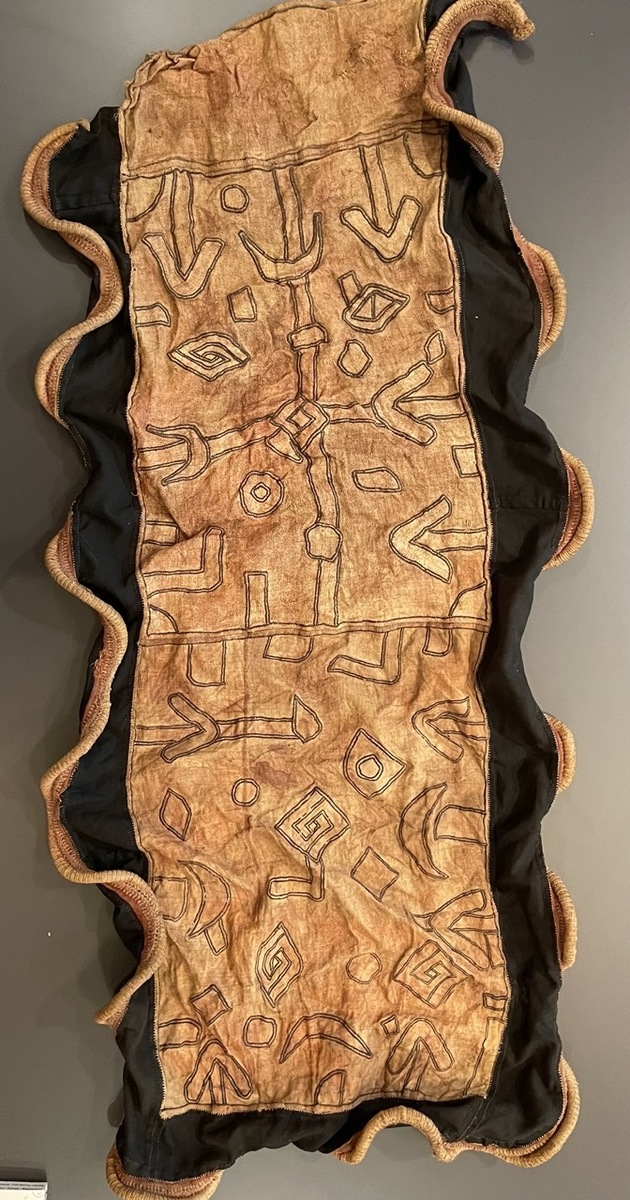
Consider a Kuba ceremonial skirt from the Democratic Republic of the Congo. Kuba men weave the raffia cloth. The women decorate it, often several women of one family each working a section. At first glance the composition looks chaotic: geometric forms changing direction, patterns interrupted, repetition without mechanical precision.
Look longer and a visual intelligence appears. Rhythm without rigid symmetry. Balance without uniformity. Museums compare these textiles to jazz, repetition and improvisation in the same breath. The Kuba artist understood that beauty does not need perfect symmetry. It can come from interruption and surprise.

The Zulu ukhamba speaks a different language. It is a communal beer vessel, coil-built by women potters who pass the craft from mother to daughter. It is burnished black and ringed with raised amasumpa. They give the hand a grip, and scholars link them to older scarification patterns and to wealth and nourishment. A functional form becomes sculpture through material, proportion, surface and touch.

A Syrian sunduq al-‘arous, the bride’s chest, speaks yet another. Walnut, mother-of-pearl and bone, made to carry a bride into her new life. On ours, paired lions face each other across an arched niche, framed in endless vine. It is not ornament. It is a family’s hopes made permanent.
These are not secondary art forms. They are distinct systems of aesthetic thought.
3. Rarity: is a rare object always a masterpiece?
No. True rarity is where scarcity, significance and artistic distinction meet. The conventional market measures rarity by surviving numbers, condition and comparables. Those matter for ethnographic art too, but they are not enough.
Take a Zulu headrest from KwaZulu-Natal, published in Headrests of Southern Africa: The Architecture of Sleep (p. 121). It passed through my hands at NOA Living and now rests in the Frédéric Zimer Collection, Paris. A single gently curved bar sits on five rectangular legs. Three are carved with crossing diagonals and two with a fine grid, alternating like a drumbeat. Many headrests share this form. Few handle it with this confidence.

So rarity must include rarity of expression. How inventive is the work within its tradition? How confidently does it interpret inherited forms? Does it say something others don’t? An object can belong to a well-known category and still be exceptional. And an unusual object is not automatically a masterpiece just because few like it survive. See the Zulu headrests in our collection.
4. Provenance: what if there is no paper trail?
An object with an undocumented history is not an object without history. In the Western market, provenance is a chain of ownership: studio, gallery, collector, museum, auction house. For many African objects, that paper trail is thin or missing. These works came from communities where making was bound up with ceremony, family and belief. Their histories were carried in memory, not invoices.
Some were commissioned for special occasions. Others passed through generations of use, repaired and adapted along the way. And many were displaced through trade and colonial collecting, a history that demands honest examination. We cannot impose the paperwork standards of the European painting market on every culture and treat missing records as missing importance.
The object itself can testify. The softened edge of a headrest after generations of use. The repairs on a textile. The burnish on a vessel. Patina, properly read, is evidence of human hands across time. It is not proof on its own. Age, authenticity and lawful ownership still require rigorous research, documentation and, wherever possible, the voices of the communities that made these works.
Scholarship is catching up. Headrests of Southern Africa: The Architecture of Sleep documents hundreds of headrests from KwaZulu-Natal, Eswatini and Limpopo. Rather than filing them under tribal labels, it records the individual owners and carvers, often with their portraits. I’m proud that headrests that passed through NOA Living now sit in one of the collections documented in its pages. This is what provenance can look like for African art: names, faces and stories gathered in the field, not only invoices.
5. The X-factor: why do some objects change how we see?
The greatest works don’t just earn admiration. They change how we see. Why does one object stop you while a similar one leaves you cold? Why can a plain wooden figure hold more presence than an elaborate sculpture? Why does a textile woven generations ago, far from our own lives, speak so directly?
Because some objects create a human connection. A great ethnographic work speaks to the culture that made it and to someone who has never encountered that culture. It reminds us that the walls between fine art, function, craft and culture were always thinner than we were taught.
Toward a new understanding of value
I’m not arguing that artistic merit should replace appraisal, market comparison, scientific analysis or provenance research. A price must be supported by evidence. But financial value and cultural significance are not the same thing. An auction tells you what someone paid on one day. It doesn’t tell you what an object has given to human culture.
A more honest framework would weigh cultural authorship, originality, the intellectual depth of the motif, mastery of craft, material history, and influence beyond the place of origin. And it would listen far more closely to the communities whose knowledge gives these objects their meaning.
African art’s achievement is not that the West eventually recognized it. Its originality and sophistication were there long before recognition arrived. Perhaps the real revolution isn’t learning to put a higher price on these objects. It’s learning to see the value that was always there.
Frequently asked questions
How is African art valued?
African art is valued on artistic quality, age, condition, rarity, provenance and market comparables. A fuller assessment also weighs cultural authorship, the meaning of its motifs, mastery of craft, evidence of use, and its influence beyond its place of origin. Published references and documented collection history add significant weight.
Does African art need a known artist to be valuable?
No. Most historical African works have no recorded maker, yet many are masterpieces. Value comes from the quality of the work, its place within a tradition, and its cultural significance. Where a carver or owner has been documented, as in recent field-based scholarship on southern African headrests, that information adds to an object’s story and value.
What is provenance in ethnographic art?
Provenance is the documented history of an object: who made, used, owned and sold it, and when. For ethnographic art it can include field-collection records, dealer and collector histories, publications, exhibition records and oral history. Responsible collecting also asks how an object left its community and whether that history was lawful and ethical.
What is a Zulu headrest?
A Zulu headrest is a carved wooden support used while sleeping, traditionally made in KwaZulu-Natal, South Africa. Many were personal objects owned by an individual. Their legs and surfaces often carry incised geometric patterns, and the best examples are prized by collectors as sculpture. View our Zulu headrests.
What is a Kuba textile?
Kuba textiles are raffia cloths from the Kuba Kingdom in the Democratic Republic of the Congo. Men weave the raffia, and women embroider and appliqué the geometric patterns, often working together on one skirt. They were worn in ceremonies and used as wealth and tribute. View our Kuba textiles.
See these objects in person
NOA Living’s collection of African and ethnographic art, wedding chests and textiles is on view by appointment at The Mill, 423 Lakeside Avenue, Suite 100, Burlington, North Carolina. Call 919-400-0772 or ask us about an object, its provenance or a private viewing.
About the author
Ehssan (Sam) Nehme is the founder and CEO of NOA Living, a design house in Burlington, North Carolina. He collects and handles African and ethnographic art and works extensively across West, North and South Africa. Headrests that passed through NOA Living are published in Headrests of Southern Africa: The Architecture of Sleep.
Sources
- Christian House, “Pricing the Priceless: How to Value Vincent van Gogh,” Sotheby’s
- The Museum of Modern Art, Les Demoiselles d’Avignon
- Art Institute of Chicago, Woman’s Ceremonial Skirt, Kuba
- Bowers Museum, Skirt (Nshak), Kuba
- Lam Museum of Anthropology, Wake Forest University, Zulu beer pot
- Bruce Goodall, Frédéric Zimer et al., Headrests of Southern Africa: The Architecture of Sleep, 5 Continents Editions, 2021