Description
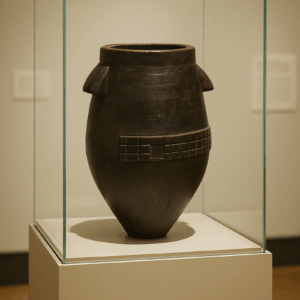
This Ithunga Zulu milk pail is an authentic sculptural vessel of utility and prestige. The Zulu people of KwaZulu-Natal made it in the early to mid-20th century. Its carver hewed it from a single block of dense, fine-grained hardwood. Its minimalist form, tactile surface and cultural resonance make it a distinguished addition to any collection of African domestic art.
Form and Craftsmanship of the Ithunga Zulu Milk Pail
First, the silhouette is a tapering ovoid with squared lug handles. Traditionally, these lugs allowed suspension with leather thongs or fiber cords. Decades of handling and repeated use have burnished the surface to a rich patina. Its most arresting feature is a carved, raised geometric medallion. In detail, this embossed oval consists of neatly arranged pyramidal studs. Furthermore, the pail is closed at the base and narrow at the neck. This design minimized spillage and contamination, joining elegance with ingenuity.
Cultural Context
The medallion symbolizes status, individuality and, in some interpretations, fertility. As a result, such embellishment raised the pail beyond its function, making it a personal item of pride. Families often gave these pails as gifts during courtship or used them at weddings and cattle ceremonies. In fact, the motifs serve as a visual language of identity and regional lineage among the amaZulu. Above all, milk carries sacred connotations in Zulu culture, as a life-giving substance offered to guests, ancestors and gods. Accordingly, the Ithunga was a vessel of both nourishment and reverence. Its preparation involved a strict regimen of smoke-curing and hygienic ritual that kept the milk sweet and enduring.
Provenance
A Catholic priest active in the region between 1930 and 1960 collected this pail. Consequently, the Ithunga Zulu milk pail is a rare example of pre-modern craftsmanship preserved with its full context of use. Its patina still speaks of its intimate role in the domestic and social rituals of Zulu pastoral life.
Display
Today, the pail suits a plinth or open shelf where the medallion catches side light. Keep it away from heat and direct sun. You are welcome to view it at our Burlington showroom.
Explore the Collection
Discover more in our objects and statues collection, or browse all antiques and ethnographic objects. You may also appreciate Currency Blade (Throwing Knife Form)Lombo or Lokele Peoples, Democrati and Bamoun Royal Ceremonial Pipe, Foumban Region, Grassfields, Cameroon. To view this piece in person, visit our Burlington showroom or book a private consultation. For broader context, read about African art.