

Description
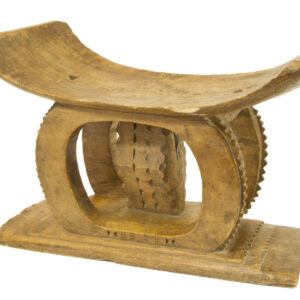
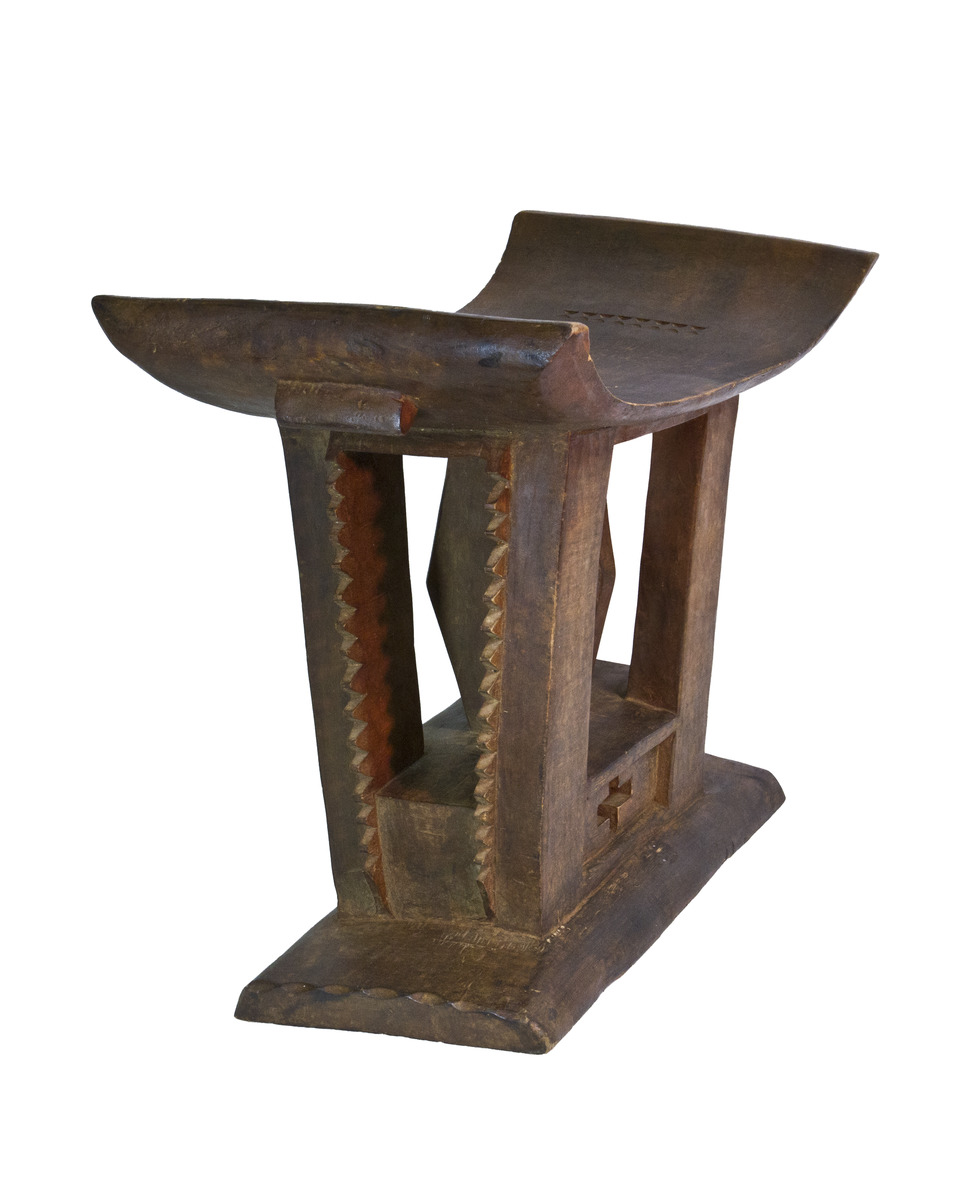
Serrated outer edges define the pillars of this notched pillar Ashanti stool, catalogued as AAS-5140. It measures 10.5 x 21 x 16 in and weighs 15 lb. In addition, a small cross-shaped piercing opens the central support. The wood carries an even medium brown tone. In our group, it sits at a moderate, mid-range scale.
Reading the Notches
The notched edges catch light in a steady sawtooth pattern. Meanwhile, the single cross piercing gives the center a quiet focal point. By comparison, AAS-5120 carries deeper serrations on its outer pillars. Here the effect stays measured and balanced, which suits a smaller room.
Lineage Carried in Wood
Memory sits at the heart of this form. In Ashanti culture, a stool keeps the lineage of whoever bears it in memory (“Kingdom of Ashante” 2017). It also functions as a universal icon of authority, achievement and power. The Ashanti, a West African people, originated in the empire whose name they share. Today, southern Ghana is their homeland.
Tree, Ceremony and Craft
Each stool begins as a solitary block of “tweneboa” or “sese” wood. Ceremonies first honor the tree, bless its wood and acknowledge nature’s sacrifice. Consequently, the carver works material already treated with respect. Where tree rings show on the surface, they add a natural layer of beauty.
The Notched Pillar Ashanti Stool on Display
Its curved seat climbs at both ends. Physically it embraces the user, and symbolically it gives the soul refuge. Etchings cut into the faces and rim stand for the owner’s achievements. Thus, the notched pillar Ashanti stool deserves a place where people can study it closely. A reading corner or hallway niche suits it well.
Explore the Collection
Discover more in our spider and Ashanti stool collection, or browse all antiques and ethnographic objects. You may also appreciate Nayansapow Dwa,The Wisdom Knot (Ancestor Stool, Ashanti People, Ghana) and Ancestor Stool (Ashanti People, Ghana). To view this piece in person, visit our Burlington showroom or book a private consultation. For broader context, read about African art.
Literature
“African Ceremonial Stools and Chairs.” https://africa.si.edu/exhibits/legrain/Afstools.htm “Kingdom of Ashante” BBC Motion Gallery: 2017 https://www.youtube.com/watch?v=5RKNMLn3zcA