Description
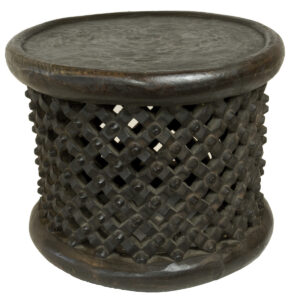
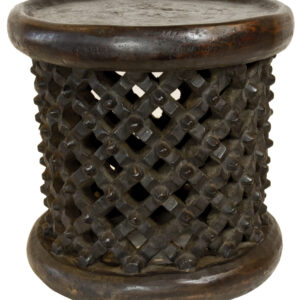
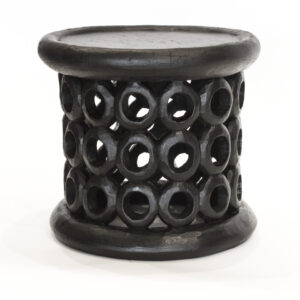
This authentic Bamileke spider stool comes from the Bamileke, a grassfields people of the West Region of Cameroon. The Bamileke speak one or several of the eleven languages native to this area. Artisans carved these “Spider Stools” from a single hardwood block, the trunk of the coffee shade tree local to the region. As a result, every element of the stool belongs to one continuous piece of wood.
Cultural Context
The Bamoun, a Royal Family within Bamileke culture, built these specific pieces. Their raw material comes from a generous source. Local farmers donate their coffee shade trees once the trees become overgrown. Consequently, the wood reaches the Family at the request of those farmers. Preserving the structure and finishes of such pieces requires a deep knowledge of craft. Above all, that knowledge has passed down through centuries via oral tradition.
Iconography
Every line of the carving draws on a Bamileke account of the origins of life. In that account, the female spider wove the web, which then “captured” creation. Therefore, the spider lives in the stool twice, once in the physical design and once in spirit. Meanwhile, as it burrows into the ground, the spider becomes the link between the living world and the afterlife.
Form and Function
In their time, these stools seated nobility and those seeking audience in royal circles. The Kingdom of the Bamileke was expansive, so craftsmen had to consider travel. They rendered the stools transportable, which let people hand carry them from village to village. Above all, this union of ceremony and practicality defines the character of the piece. In this way, the stool traveled with the life of the kingdom.
Displaying the Bamileke Spider Stool
Give this Bamileke spider stool a position where viewers can walk around it and study the carving. It suits an entry, a study or a gallery wall grouping. Keep it out of strong direct sun and dust it lightly with a dry cloth. Viewings are available by appointment at our Burlington showroom. Also, it sits comfortably within a mixed collection of carved objects.
Explore the Collection
Discover more in our spider and Ashanti stool collection, or browse all antiques and ethnographic objects. You may also appreciate a companion piece and another piece from this collection. To view this piece in person, visit our Burlington showroom or book a private consultation. For broader context, read about African art.