Description
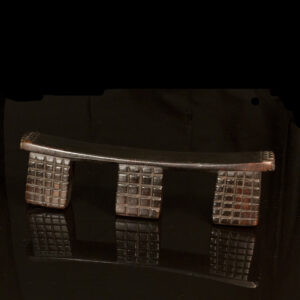
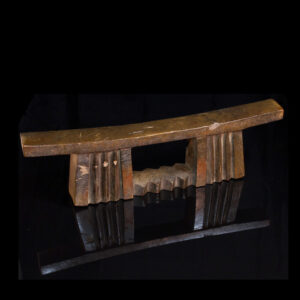
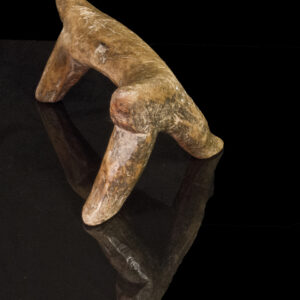
The Mingudeni Shezi headrest, No. 11 (ZHR-1011), is an authentic work of Zulu craftsmanship. It measures 4.25 x 19 x 5 in, the tallest of our small Zulu headrests. Three pale legs stand under a lighter top. Meanwhile, a central lug hangs vertically between them and commands attention.
Two Faces of ZHR-1011
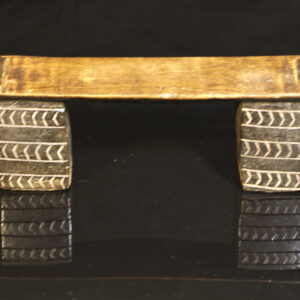
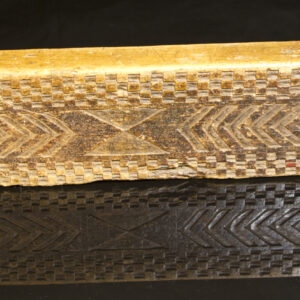
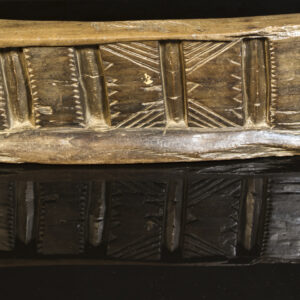
The originality of this piece lies in its contrasting sides. Each face carries a different geometric pattern, and the two never repeat. On one side, small and large squares and rectangles form an intricate arrangement. On the reverse, parallel lines run along the legs. In addition, concentric rectangles embellish the lug.
Balance in the Mingudeni Shezi Headrest
The hanging lug suggests weight and strength. By contrast, the platform above sits in equilibrium, as if bracing under the load. Consequently, the Mingudeni Shezi headrest reads differently from every angle. It rewards being turned and studied.
Geometry and Zulu Meaning
In Zulu culture, these geometric designs hold symbolic meaning. The varied shapes represent the complexities of life and the balance of opposing forces. For example, the squares and rectangles symbolize the stability and structure of one’s home. Similarly, the parallel lines signify the journey through life and the importance of community. Finally, the concentric rectangles on the lug embody the layers of ancestral connection.
Among our small Zulu headrests, only this one bears a hanging lug. Its two contrasting faces also make it unusual within the group. Moreover, its 4.25 in height is the greatest of the small examples. For these reasons, it often serves as the anchor of a display.
Because both faces matter, place the Mingudeni Shezi headrest where viewers can walk around it. Raking light also sharpens the incised geometry. A visit to our Burlington showroom will show both sides.
Explore the Collection
Discover more in our headrest collection, or browse all antiques and ethnographic objects. You may also appreciate Headrest No. 1012 (Zulu People, Southern Africa) and Headrest No. 2250 (Zulu People, Southern Africa). To view this piece in person, visit our Burlington showroom or book a private consultation. For broader context, read about African art.
Literature
Bishop, S.D. 1986. African Headrests. Scholar.ufs.ac.za. Johannesburg Art Gallery. 1991. Art and Ambiguity: Perspectives on the Brenthurst Collection of Southern African Art. Johannesburg: Johannesburg Art Gallery. Nettleton, Anitra. 2007. African Dream Machines: Style, Identity and Meaning of African Headrests. Johannesburg: Wits University Press.