Description
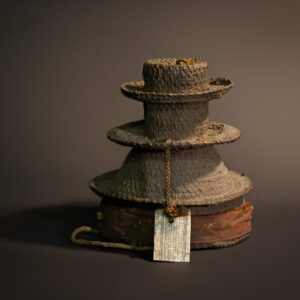
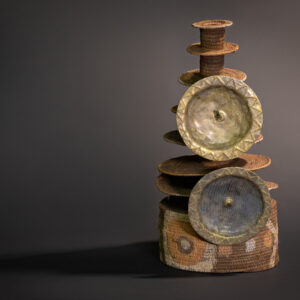
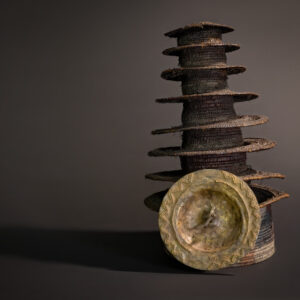
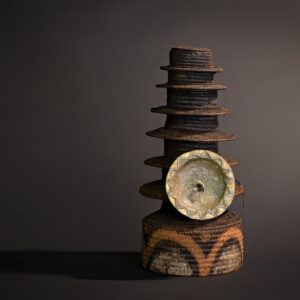
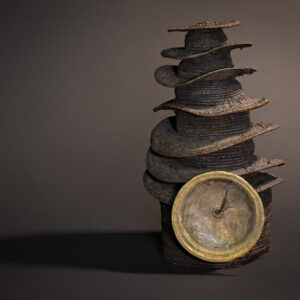
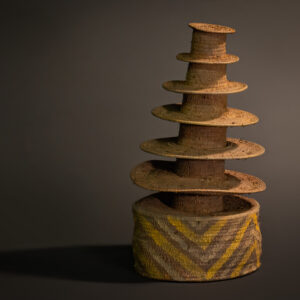
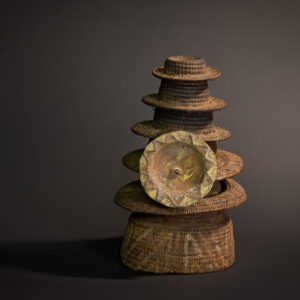
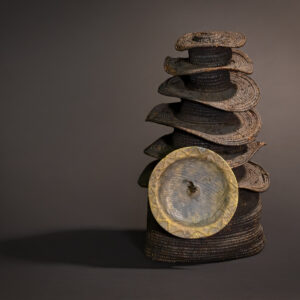
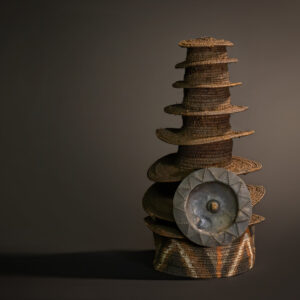
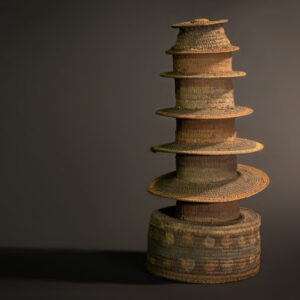
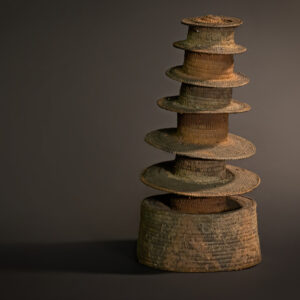
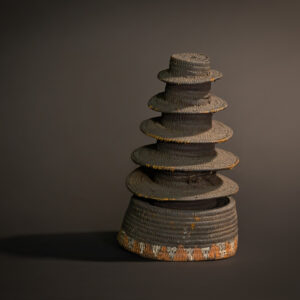
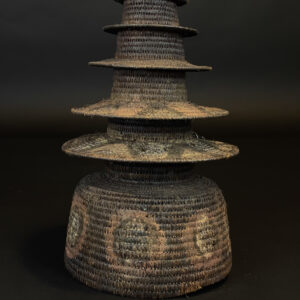
This authentic eleven tier Botolo hat towers with quiet authority. Its eleven precisely stacked tiers form an architectural image of cyclical life, generational passage, and cosmic rhythm. Moreover, its sculptural form and natural coloring express the Ekonda worldview, in which hierarchy, ritual, and ancestry spiral into an unbroken continuum.
Cultural Context
The number of tiers was never arbitrary. In many central African cosmologies, layered construction reflected status, age, and spiritual proximity to the ancestral plane. Here, eleven suggests a heightened connection to both lineage and celestial cycles. Indeed, it is a number steeped in transition and leadership. The Power of Headdresses (Biebuyck & Van den Abbeele, 1984) references such forms. According to that work, they play vital roles in public performance, inheritance rites, and declarations of social standing.
Form and Craftsmanship of the Eleven Tier Botolo Hat
Makers handwove each tier from indigenous forest fibers. Every tier also mirrors the growth rings of a tree or the concentric ripples of water. Both images suggest life unfolding from a central source. Because it has no metal disks, the hat honors form over material display. Its undulating silhouette sits slightly off-center. As a result, it recalls termite mounds, tree spirals, and stacked ritual vessels, symbols of the living forest and its spirits. Its warm brown palette, darkened by camwood and ceremonial oil, holds a soft sheen of ritual use. It also keeps a surface memory of smoke-filled enclosures.
Provenance
Acquired in Kinshasa in the early 1970s from a young Ekonda noble.
Scholarship
The lack of embellishment does not weaken its impact. Rather, it sharpens the message of the hat: life, like the tiers, is a cycle of continuity, resilience, and return.
Display
Simple surroundings in wood, stone, or linen allow its craftsmanship to take the lead. An eleven tier Botolo hat makes a strong vertical accent in a modern room. A stable plinth with space around it suits the form. In addition, keep it away from direct sun, vents, and humidity. You are welcome to view it at our Burlington showroom.
Explore the Collection
Discover more in our headdress collection, or browse all antiques and ethnographic objects. You may also appreciate Rhythms of the Cosmos and Echo of the Ancestors. To view this piece in person, visit our Burlington showroom or book a private consultation. For broader context, read about African art.
Literature
The Power of Headdresses (Biebuyck & Van den Abbeele, 1984)