Description
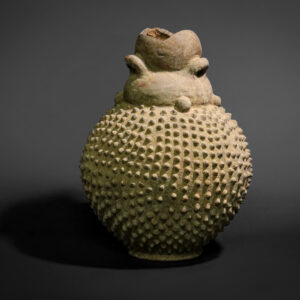
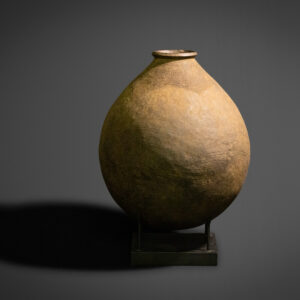
This authentic Wiiso ancestor vessel, reference AUV-0060, is a hand-built terra-cotta figure from the Ungur of Nigeria. It measures 10 x 10 x 18 in and has a pale cream surface. The bottle form rises from a textured, globular body to a cylindrical neck. A face is modelled on that neck, and a lid-like cap crowns it.
Catalogue Note: AUV-0060
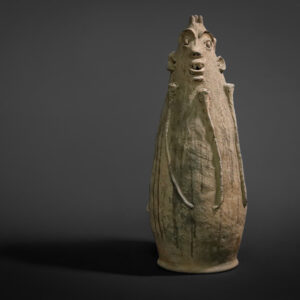
The vessel takes the form of a whimsical male figure. Applied arms and shoulder elements also sit against the body. In fact, stick-thin arms drape over a playfully full belly, and that belly forms the vessel itself. Above, the face shows an implied smile and a positive countenance. As a result, the figure reads as warm and good-humored. Two examples of this vessel are in stock, so it may be acquired singly or as a pair. Among our terra-cotta pieces, the pale cream clay distinguishes it from the darker Batwa pots.
Ancestors in Clay
Among the Ungur, such vessels embody ancestors. Marla Berns described their role precisely: “As ancestors, such vessels help structure and legitimize social relationship among Ungur People. The reality of their ancestors is inseparable from the reality of ceramic symbols which dwell in these pots…” (Berns 1990). In other words, the Wiiso ancestor vessel helps order relationships among the living.
Made by Yungur Women
Yungur women always construct these vessels. Therefore, each one belongs to a female ceramic tradition. Moreover, the potter builds the form by hand, joining container and portrait in one object. Consequently, the body holds while the face remembers. That union of function and likeness defines this body of ancestral ceramics.
Displaying the Wiiso Ancestor Vessel
Show this ancestor vessel at eye level on a plinth or console, where the face can meet the viewer. For example, soft side light will model the belly and arms. A plain wall behind it keeps the bottle outline clear. Keep it in a stable room, clear of damp air and strong sun.
Explore the Collection
Discover more in our pottery and terra-cotta collection, or browse all antiques and ethnographic objects. You may also appreciate a companion piece and Three Spouted Vessel (Bukusu People, Kenya). To view this piece in person, visit our Burlington showroom or book a private consultation. For broader context, read about African art.
Literature
Burns, Marla C. 1990. Pots As People: Ungur Ancestral Portraits. Los Angeles: African Arts. Vol. 23, Iss. 3.